How to Watch the Turkish Süper Lig
·5 min read
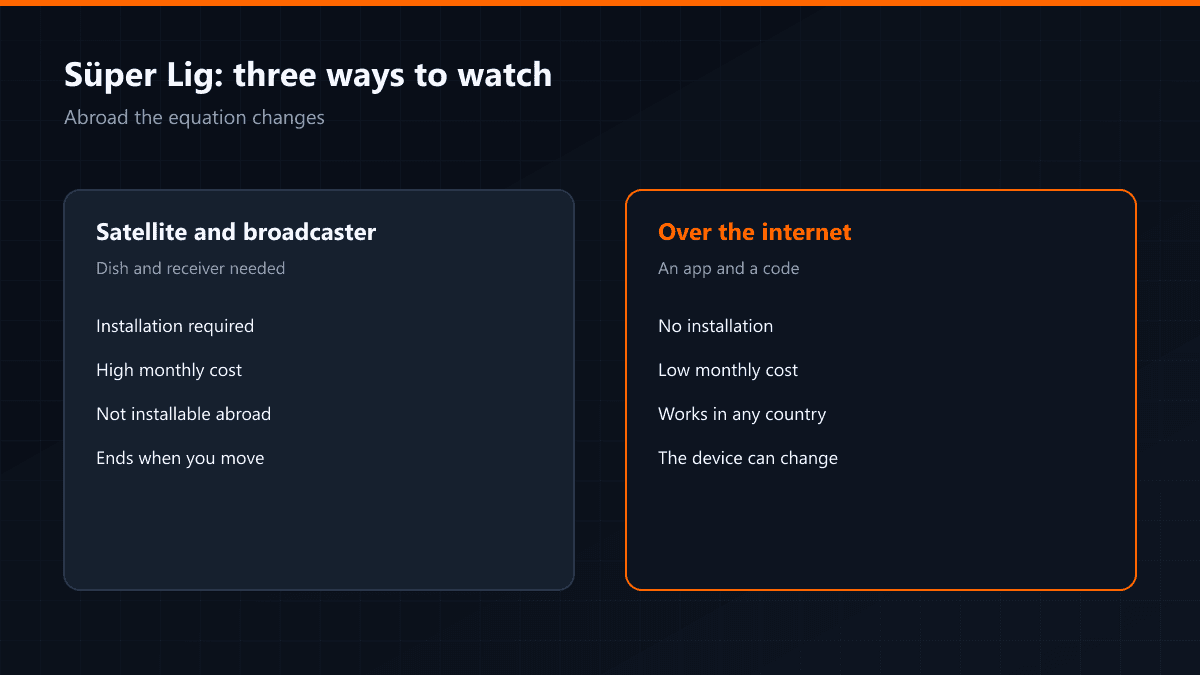
Süper Lig broadcast rights sit with a single rights holder in Turkey, but there is more than one way to watch. At home the equation is simple; abroad it changes, because the same subscription is not sold in every country and where it is, both the price and the setup differ.
Three routes, three costs
| Route | Setup | Monthly cost | Abroad |
|---|---|---|---|
| Satellite plus subscription | Dish and receiver | High | Not installable in most countries |
| The broadcaster's own app | App and account | Medium | May carry country limits |
| IPTV membership | App and a code | Low | Works wherever there is internet |
What changes abroad
For someone living in Germany, the Netherlands or France, the Turkish satellite setup is effectively unavailable: even with a dish installed, the encrypted channels on that satellite cannot be received there. That leaves internet delivery, and the only requirement is a connection that holds up.
Match-day preparation
- 01Measure the line before kickoff10 Mbit is enough for Full HD, 25 Mbit for 4K. Measure at match time: your speed at 20.00 is not your speed at 10.00.
- 02Open the channel earlyTune in ten minutes before kickoff. If the picture is stable then, it will hold; if something is wrong, you still have time to fix it.
- 03Keep a backup channel in favouritesThe same match is usually carried on more than one channel and in more than one quality. Add both to favourites so one button switches you over if the first one stutters.
- 04Prefer a cableWi-Fi is at its busiest exactly at match time. Plug in Ethernet if you have it; if not, move the device closer to the router.
How many people can watch at once?
One membership means one screen. If two matches are being watched in the same house, the second screen needs a second line. That is worth asking before derby night rather than discovering it as two televisions come on.
During match windows the free trial is 1 hour, not 6. The reason is plain: server load peaks in that window and free accounts eat the bandwidth paying customers are using.