IPTV in Sweden: Long Winters, Distant Satellites
·5 min read
A household in Sweden that wants Turkish channels faces a concrete geographical problem: the further north you go, the less a satellite dish works. In the same home a fibre connection is usually already in place — which is why the decision here is unusually clear.
Why satellite gets harder
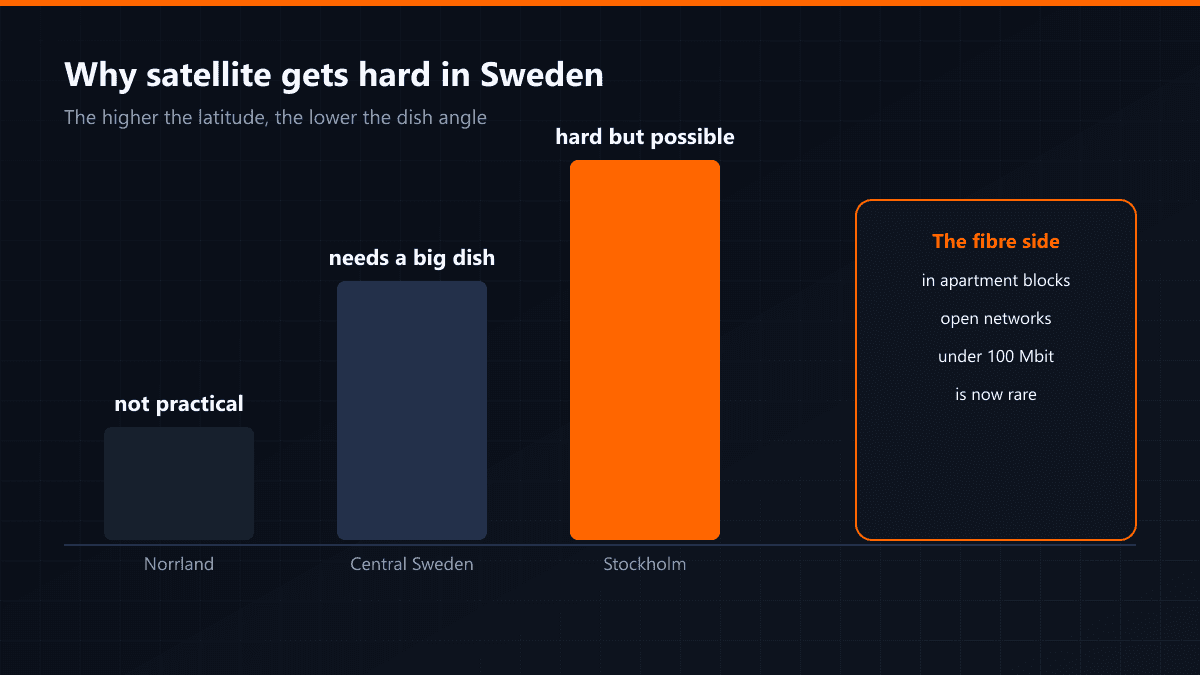
A dish aimed at Türksat has to look closer to the horizon as latitude rises. In Stockholm that angle is already low; around Umeå and further north a tree, a building or a hill gets in the way. A larger dish helps up to a point, and after that it is physics.
| Region | Satellite | Fibre coverage |
|---|---|---|
| Stockholm, Gothenburg, Malmö | Hard but possible | Very high |
| Central Sweden | Needs a large dish | High |
| The north (Norrland) | Not practical | High in apartment blocks |
Why the fibre side is easy
Most Swedish apartment buildings are connected to open fibre networks and the tenant picks their own provider. Telia, Bahnhof and Tele2 all serve over the same physical network; the speed difference comes from the package rather than the infrastructure. A package below 100 Mbit is now rare in Sweden.
Which server?
The European one. The distance from Scandinavia to Frankfurt is far shorter than to Turkey, and that shows during a live match. Through the long winter evenings, when load peaks between seven and ten, a wired connection helps as well.
Local channels
Swedish channels such as SVT1, SVT2 and TV4 are in the list. In Turkish households around Stockholm where the children watch in Swedish, one subscription serves both sides.