IPTV in Austria: City Versus Mountain Valley
·5 min read
The IPTV experience in Austria splits in two depending on where you live. In Vienna, Linz and Graz connections sit above the European average; in alpine valleys copper lines and limited speeds are still common. That is the one thing to check before setting anything up.
City versus countryside
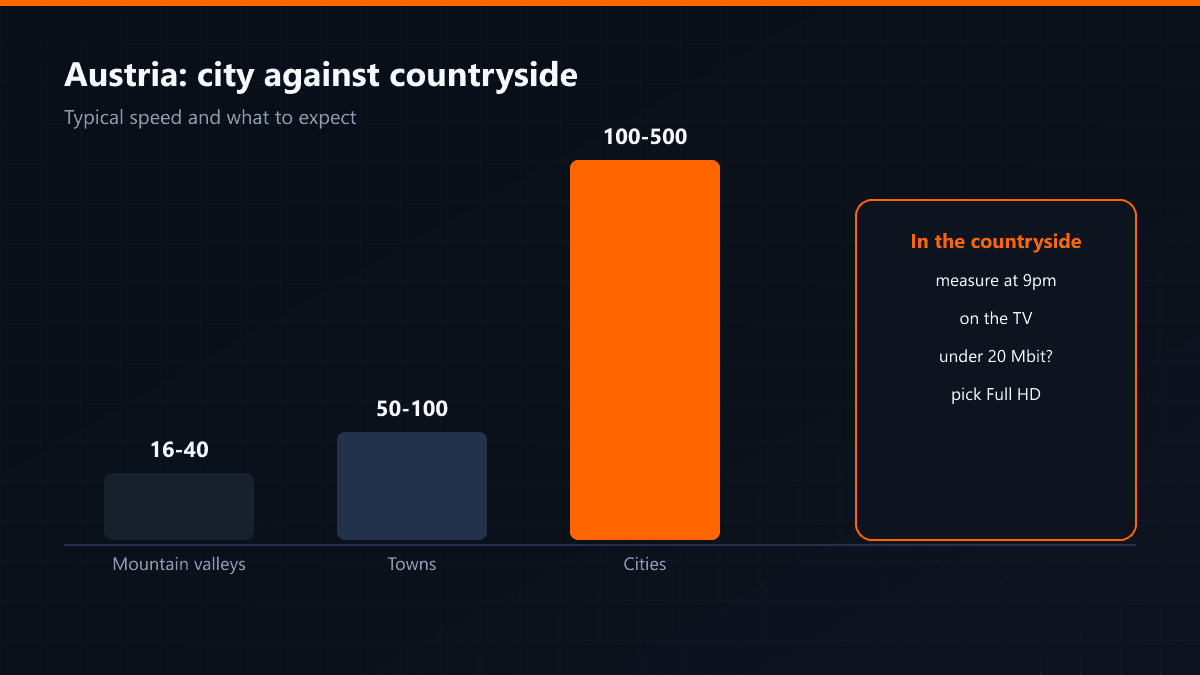
| Where | Typical speed | What to expect |
|---|---|---|
| Vienna, Linz, Graz | 100-500 Mbit | Trouble-free including 4K |
| Towns | 50-100 Mbit | Comfortable in Full HD |
| Mountain valleys | 16-40 Mbit | HD; 4K may struggle |
A1 covers the country and is often the only option in rural areas. Magenta runs on cable and is faster in cities, but the effect of sharing shows in the evening.
In the countryside, measure first
Run the test from the room where the television sits, and run it around nine in the evening. If the steady figure is below 20 Mbit, choosing the Full HD version of a channel over the 4K one gives a better result than fighting constant freezing.
Which server?
The European one. Austria sits in the middle of Central Europe and close to the Frankfurt routes, which is a comfortable position for latency. There is nothing to gain from the Turkish server here.
ORF and local channels
Austrian channels such as ORF 1, ORF 2, ATV and Puls 4 are in the list. The Austrian broadcasting fee is a separate matter and has nothing to do with an IPTV subscription; neither replaces the other.
In mountain regions snowfall interrupts a satellite signal but leaves the internet connection alone. For households that watch on a dish and struggle every winter, that is IPTV's most concrete benefit here.