IPTV and Turkish Channels in Norway
·5 min read
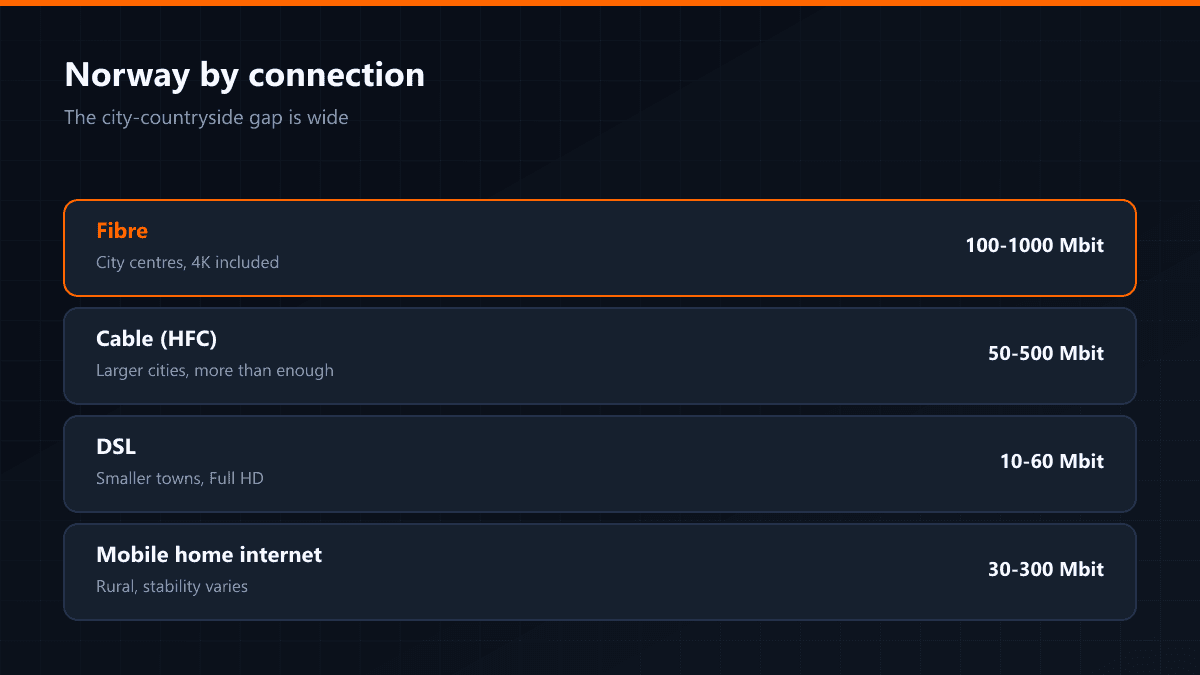
A family in Norway reaching Turkish channels is doing it in one of the technically easiest countries in Europe: the national internet infrastructure sits above the European average. That average is misleading on its own though, because the gap between city and countryside is wider here than in most places.
The connection picture
| Connection | Typical speed | Where it is common | For IPTV |
|---|---|---|---|
| Fibre | 100 - 1000 Mbit | City centres | Fine including 4K |
| Cable (HFC) | 50 - 500 Mbit | Larger cities | More than enough |
| DSL | 10 - 60 Mbit | Smaller towns | Full HD is fine |
| 4G/5G home internet | 30 - 300 Mbit | Rural areas | Stability varies |
What changes outside the cities
Along the fjords and in mountainous areas wired infrastructure does not reach every address, and mobile home internet is the common answer there. The headline speed looks good, but latency and stability on those connections behave differently from a wired line. As more households on the same mast come online in the evening, streams can stall — so the number to measure is not the peak, it is the speed at 21.00.
Setup steps
- 01Measure the line in the evening200 Mbit in the morning can be 40 Mbit at night. IPTV is watched in the evening, so the decision belongs to the evening figure.
- 02Choose the deviceIf the television runs Android TV or Google TV you install directly. If not, a small box or stick is the most practical route.
- 03Install the app and enter the detailsSign in with the address and credentials you were given. The first list download takes a few minutes.
- 04Check the time zoneNorway is an hour behind Turkey. If guide times look shifted, correct the time zone setting in the player.
Winter considerations
Evenings get longer in winter and people spend more time at home; network load rises with it. A wired connection is what you notice most in this period. If you have to watch over Wi-Fi, moving the device to the 5 GHz network and closer to the router ends most of the stalling.
The gap to Turkey is one hour, but it widens to two in summer: Turkey does not change its clocks and Norway does. Recheck match times at the end of October and the end of March.